"We cannont solve our problems with the same thinking we used when we created them."

Albert Einstein

[Originally posted May, 15, 2009]
(This semester our class had the opportunity to have Adam Bly of Seed Media Group as a guest speaker. I asked him his opinion on the role of education in scientific literacy, specifically for the piece I wrote and posted here earlier. The following is the response he sent me. Thanks Adam!)

At the heart of how I feel about science education is the idea that science should be used as a lens through which to look at the world, not just a subject to be taught. And further; science education goes on forever and should be available to everyone.

We live in a world where we now produce more information in a year than in all prior human history combined. Graduating college no longer means you know the essentials of your field. Fields merge and change with new data. Walls between scientific disciplines are torn down. Education must run parallel with any successful pursuit of a profession. We now see universities cater to this new reality. Many universities offer their course material for free. It’s a great model. What the universities can still offer exclusively to their paying students, is valuable access to professors and a network of other students.

But the bigger picture in my view of science education is a scientifically literate nation. That’s the goal. To have a population that understands scientific concepts and processes is more crucial to the progress of our country, than churning out a certain number of scientists and engineers.

In order to translate this ideal to the classrooms, teachers and anyone else in charge of shaping curriculums, must acknowledge science as a prime driving force in society. The teaching of natural sciences should be as actively connected to and engaged in current events and advancements as the social sciences are. Science education needs to be connected to science news.
Continue reading →

February 14, 2010

Books, Features

5 comments

A friend told me a few months ago that when he was going through heartbreak, he found his way through it by reading an entire graphic novel series in a slightly obsessive binge. He assured me that I would find something to help me through my heartbreak as well. This hopefully is my graphic novel series, not literally of course. For me, it is Jonah Lehrer’s How We Decide.

As strange as it may seem, making sense of what is going on in my brain and in my heart seems to be the only way out of heartbreak for me. Somehow, figuring out some of the things that might be causing me to feel pain is therapeutic and somewhat exciting. I want to know why I feel the way that I feel and why things happened the way that they did. I might be able to parse out some things for that first half but probably not the second half.

Heartbreak has been so difficult to deal with because I feel broken by the loss of love. I’m thinking it is at least partly loss aversion, a concept that means people strongly prefer avoiding a loss, and that feeling might be stronger than the desire to acquire a gain.

Loss aversion is a theme that comes up in How We Decide, mostly when dealing with gambling and betting. People who are losing money are more likely to keep gambling or hold on to depreciating stocks because the thought of leaving at a loss is too much to bear. Loss aversion can be linked to some irrational decisions and/or behavior.

The neuroscience behind this suggests that certain areas of the brain increase in activity when the potential gains increase and decreasing activity may represent potential losses. Neural signals could be measured to try to predict loss aversion behavior by comparing the relative activity induced by the gains and losses.

For me, the thought of not being able to create more happy memories with that person is unbearable. I feel unsatisfied with the way things ended and have the urge to hold on until things look better. This is irrational of me and I know that, but my emotions won’t let me accept that loss very easily.
Continue reading →

February 3, 2010

Features, Science, Society

2 comments

We may all be familiar with the face of hunger, but undernutrition may be more difficult to detect and treat. Last Tuesday, I attended a lecture by Dr. Jessica Fanzo of the Earth Institute’s Center for Global Health and Economic Development. She spoke about “Global Progress in Ending Hunger and Undernutrition.”

Some symptoms of undernutrition may include stunted growth for children, and overweightness for adults (due to a poor diet). Undernutrition is linked to lack of access to nutritious foods and poor economic opportunities.

Their Millenium Villages Project focuses on 4 main micronutrients: vitamin A, iron, folate, and iodine. These are essential micronutrients that when deficient are known to affect development, immune system function, and can increase disease risk, particularly of young children and pregnant women.

In general, micronutrients are compounds that are found in very small amounts. Plant health is pretty dependent on certain micronutrients in the soil, such as boron, calcium, zinc, iron, and chlorine.

But nutrition is complex and we do not have a full understanding of how it relates to human health, and that is why Dr. Fanzo promotes an overall approach that emphasizes a diverse diet that includes leafy greens and appropriate portions of carbohydrates and eggs or animal protein.

It is a complex problem overall because of a few major factors:

  • Nutrition and health issues are “political, administrative, and institutional orphan” because it is “everybody’s business and nobody’s responsibility”
  • As a result, there is a lack of political commitment
  • Nutrition focused programs are difficult or less popular to fund
  • Cultural factors make it tricky to gather support for initiatives

Global food issues are not just about availability of food, but of high quality food. We are still trying to figure out what that is, but we do know that a diverse diet of plants is essential to a healthy body. It saddens me to see that people consistently choose foods that are known to be bad for their health, when there are better alternatives. Especially in the United States, I’m ashamed of what our food culture has become. It happens here and it happens in poor countries as well, according to Dr. Fanzo. Women in the Millennium Villages Project’s villages eat large portions of refined maize meal daily, when native leafy greens are plentiful.

What is difficult now is, how do can people change their food choices and eating behavior? No one likes to be told what to do, especially with their bodies. If that were not true, smoking would not still be as popular today as it is.

Education and advocacy alone will not work. When given a choice between a food item that is tasty but unhealthy and a food item that is healthy but less tasty, the default is to go with the tastier item. The problem is that a lot of the “tastier” stuff is so far from natural that our bodies can’t process them as well as the plants and animals we have evolved to eat.

As a species, we need to return to the foods that have worked for us for hundreds and thousands of years, and wean ourselves off of the super processed foods that hardly resemble food anymore. For the U.S., maybe that will mean government regulations on the food industry, I’m not sure. But I think the only way that undernutrition and hunger will be alleviated in many places in the world will be through planning that involves capacity building for villagers to gather and grow nutritious food. It certainly will not solve any problems to send them corn meal grown in the U.S.

Thoughts?


Related posts


Image credit: Flickr user publik16

January 20, 2010

Features, Science, Society

5 comments


Image credit: Flickr user Colin Purrington
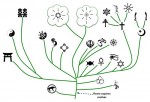
(This image created by Axis of Evo is not exactly what this entry is about, but it is an interesting use of a scientific technique to map out religions of the world.)

I wasn’t so sure what to expect when I went to the first lecture of the Earth Institute Practicum yesterday. The speaker was Bob Pollack of the Earth Institute’s Center for the Study of Science and Religion (CSSR). The first thing he did was tell us that the ideas of “right” and “wrong” are completely human constructs and that there is no evidence of them in nature.

So what is “natural” and how are science and religion connected?

Pollack’s definition of what is natural is biologically derived. DNA is the force by which things may naturally happen, and anything that happens by other means could be considered “unnatural” or derived from human imagination.

The biggest example of the latter that was discussed over the 2-hour seminar was language, not just as words, but also as ideas and general communication. Pollack explained that it was the main goal of CSSR to facilitate communication between science and religion and their practitioners. They certainly are not attempting to incorporate the two, but reconcile them so that they both can work to solve global issues.
Continue reading →

Every LEED project needs to fulfill all prerequisites and Minimum Program Requirements. These do not get the project any points towards certification. To get points, the project must include many different strategies in the different categories to add up to the threshold number of points. Read through this website for details on the process: GBCI.

Here are the different certification levels:

  • LEED certified – 40-49 points
  • LEED Silver – 50-59 points
  • LEED Gold – 60-79 points
  • LEED Platinum – 80+ points

Strategies that are used to fulfill credits are very diverse. The LEED project should be using more strategies than needed so that if some are not awarded points, then others that do get points will still count towards making it to the certification threshold.


USGBC is very careful to NOT condone specific products for LEED buildings, but instead they promote overall strategies such as low-flow showerheads and faucets. Therefore, there is nearly never a case where a product or material can be for-sure used on a LEED project to gain points. The only exception is that, as things are now, Forestry Stewardship Council (FSC) certified wood is approved for LEED (there is some controversy over this and there is talk of USGBC making their own label for wood products).


For example, the new Nintendo building will be building a green roof and including composting bins towards gaining points for LEED Silver certification. Strategies may contribute towards credits in more than one category (i.e. Energy & Atmosphere in addition to Materials & Resources).

Other strategies might include:

  • Bicycle and shower facilities
  • Light shelves in windows and shell
  • Natural ventilation
  • Constructed wetlands

For previous posts on this topic, Part 1 and more advanced notes.
For a more in-depth look at LEED in action, check out the blog Real Life LEED.

December 3, 2009

Features, Society, Technology

4 comments

This entry will focus on how the LEED rating systems are set up and the basic categories of credits. For a basic introduction to LEED, check this website.

The LEED Rating Systems are the sets of credits and categories that a LEED project team is aiming for. They are specific for the type of construction, like a new building would go for LEED for new construction, a school would go for LEED for Schools, a home would go for LEED for Homes.

Every rating system has the same set of categories, though the credits within them may be different.
The categories are:

  • Sustainable Sites
  • Water Efficiency
  • Energy & Atmosphere
  • Materials & Resources
  • Indoor Environmental Quality
  • Locations and Linkages
  • Awareness & Education
  • Innovation in Design
  • Regional Priority

The different credits in each category may be weighted to be worth more points than other credits. Some credits allow for incremental points to be earned by how much is accomplished by the building. For example, a certain percentage decrease in water usage could result in 1 point, but by decreasing water usage by then next threshold percentage could result in 2 points.

The Energy & Atmosphere category’s credits have the most potential points to be earned.

That’s it for now. I’ll be posting more on this since I’m almost done with graduate school applications, but for more advanced notes, see my previous post.