A discussion about vertical farming and some of its environmental implications
(Portions of the quoted text have been edited from the raw transcript.)
Vertical farming has been brought into the forefront recently, with a spot in the film FUEL, articles in TIME, Scientific American, as well as others in the past 6 months. What this concept entails is growing food in a controlled indoor environment in vertical structures that could be built in cities, urban centers, and as annexes to new buildings being constructed. Plants can be grown hydroponically, and even some livestock can be raised. The technology is there, as is most of the ecological understanding.
The man behind this concept is Dickson Despommier, Ph.D., a professor of medical ecology at Columbia University’s Mailman School of Public Health. He is the kind of guy who gives away copies of The Lorax to spread love for the environment. He even keeps extra copies of them on his shelf in his office at Columbia’s Medical Campus. I visited him at this office, which, by the way, has a great view of the Hudson River. When asked how this vertical farming idea developed, Despommier tells the story about how the idea came out of a somewhat failed class project investigating rooftop gardening in New York City.
Continue reading →
(This piece was written in Fall 2008.)
Climate change is important to any analysis for the future, environmentally, socially,
economically, or politically. The IPCC projects that with rising temperatures, there will be a
global increase incidence of droughts, desertification, and extreme precipitation events (IPCC
2007). The increase in temperature will also allow range expansion and better survival or
overwintering rates of disease carrying vectors such as mosquitoes. Perhaps the more terrifying
outcome for human societies could be a great reduction of food production as a result of several
factors brought on by global climate change. Any combinations of these may threaten security
within and between nations. The impacts of climate change on future food availability and public
health may increase the likelihood of resource related conflict in the most vulnerable parts of the
world.
Barnett and Adger (2007) discuss the idea that conflict can be stimulated by “changes in
social systems driven by actual or perceived climate impacts.” Their main arguments are:
1. climate change may affect human security by reducing access or quality of natural
resources,
2. human insecurity affected by climate change may increase risk of violent conflict,
3. climate change may affect the capacity of states to promote human security and
peace,
4. and that these direct effects on livelihoods and indirect effects on state functions
due to climate change may increase the risk of conflict (Barnett and Adger 2007).
Continue reading →
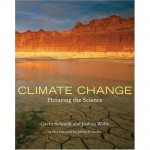
I attended a book launch today for Climate Change: Picturing the Science, hosted by the Columbia Climate Center of the Earth Institute at Columbia University.
The book is focused on how to take the science and communicate it through words and pictures. Leading climate scientists contributed to the writing of the chapters while the photographs were chosen based on what would explain and support the science.
The main authors, Gavin Schmidt and Joshua Wolfe, spoke on a panel with contributing authors Peter deMenocal and Stephanie Pfirman. Jeffrey Sachs gave a brief introduction (by video) and stressed the importance of having a worldwide understanding of the challenges that we face and that the defining component of any solution will be cooperation.
The moderator started with a few questions about the origins of the idea for the book, which was a photography show about climate change. Schmidt brought up the point that many of the books on climate change currently in stores are very political. This book, however, attempts to stay away from the politics and instead explain the science behind it all.
Continue reading →
Recent comments
Tag Cloud
academia activism behavior climate change CNN conservation development Earth Institute ecohealth EcoHealth Alliance ecology economy education energy environmental decisions evolution fall farming food geography Google graduate students greenanswers.com green building human-environment conflict In Defense of Food Internet journal article knowledge LEED Michael Pollan music Nature New York nutritionism NYT policy recycling Science scientific literacy sociology summer urban farming vertical farming Wikinomics


Commentary on “Why isn’t the brain green?”
April 23, 2009
Science, Society, Some Comments
(No comments)
The New York Times Magazine recently put out a piece by Jon Gertner about environmental decision-making and the different social dynamics that are involved. The author discusses several different studies that involve individual and group decision-making. One group doing such research is the Center for Research on Environmental Decisions is an interdisciplinary based at Columbia University that receives funding for their research from the National Science Foundation.
Gertner brings up several interesting points such as the ethics of using “frames” and “nudges” to send signals and possibly influence decisions. The idea behind these terms is that the way that a choice is “framed” could affect the outcome by taking advantage of our cognitive biases and that nudges “structure choices so that our natural cognitive shortcomings don’t make us err.”
I find it fascinating to read about studies involving decision-making, especially the ones that compare individual versus group actions. Gertner talks a little bit about the comparisons between carbon taxes and offsets, and how there generally is an aversion to the word “tax,” when in reality taxes and offsets function in nearly exact ways. Gertner also cites a study that suggests that group decisions for which individual preparation beforehand was not allowed leads to better inclusion of long term goals. This is also interesting as part of the discussion of the general bias towards information received early on in the decision-making process.
So maybe one day we could frame questions and choices so that we nudge people into making the right decisions, or at least set up a fair situation for all choices considered. But who decides what is best in the long term interest? And who is to say those who are deciding aren’t also affected by similar cognitive bias related phenomena? Possibly even some being phenomena that we are not yet aware of?
Decision-science seems to be a very pertinent field, especially in the realm of climate change related decisions. However, very little of the funding going towards climate research is going to social science studies such as these. I think that being open to these types of questions of cognitive shortcomings will become increasingly more important as challenges brought on by climate change become more complex and intricate.