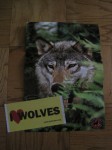
I like wolves. As a child, I loved the book “Julie of the Wolves” and as an adult I enjoyed the anime “Wolf’s Rain.”
Wolves are some of the least understood of the predators that humans have pitted themselves against over the ages, others being sharks, bears, and large cats. One of the main reasons is that they compete with humans for resources. These predators won’t usually outright attack humans unless threatened, but humans will and have killed them in scores because of food and resources. This makes it extra difficult to make the case for their conservation in the face of endangerment and extinction.
I received this poster and bumper sticker in the mail yesterday from Defenders of Wildlife, along with a letter and fliers asking me to donate to the organization with the added incentive of receiving a wolf photo book and/or aluminum water bottle.
I have supported them with a donation in the past, but I am doubtful whether I will give again.
I have a few reasons for this. The main one being that this type of physical mail is so gimmicky and quite annoying, that I do not want to encourage them to send me more by responding to it. I’m hoping that by ignoring their waste of paper (even if it is recycled paper), they will eventually stop it. It would be nice if there were a way to opt out of physical mailings and in place of that receive emails, but as far as I can tell from their website, there is no such thing.
But still, I hope that the people who are reached by their campaigns truly consider conservation more seriously than the pamphlets suggest. The materials could be more informative, but I understand that the species-focus has been one of the most successful strategies.
This is where a more scientifically literate society would be very different. Conservation groups would not have to take the single species or simple issue angle in order to garner public support.
In areas of the world where most people live in and with the environment and accompanying wildlife, human culture has deeper understanding of the relationships of the ecosystems. We may not be able to return to that type of interaction with nature in this country, but perhaps with better incorporation of science into society we can achieve something similar.
This is what I hope to contribute to with my work!
(This piece was written Fall 2007.)
Our perception of Nature has everything to do with the way that we live our lives. People who trivialize the importance of nature to their daily lives take for granted what Nature has given and allowed us to accomplish. It may seem that we may rely on Nature’s resources indefinitely, but at what cost to Nature? Our time on Earth has been but a few blinks of the eye in the great geological scale of time yet the impacts that we have made while “conquering” our domain will most likely last for much longer. Differing perspectives on Nature will define the relationships and the types of interactions that we have with Nature.
Two great thinkers who approach this topic are William Cronon and Aldo Leopold. Both believe that the characteristics of man’s relationship with Nature depend on how man approaches Nature. The overarching Western idea that the Earth with its natural resources were meant for man’s use and progress came to the Americas with the Europeans. Several thinkers argue that this school of thought is deeply rooted in religion, and so is that much more ingrained in the culture. Followers were taught that the resources given to man by nature were limitless and for the taking while in other parts of the world people believe in the interconnectedness of all things in the world. This fundamental difference in thought has lead to many advances in society but at the expense of the natural world (i.e. the Industrial Revolution).
Cronon’s article titled “The Trouble with Wilderness; or Getting Back to the Wrong Nature” discusses the common interpretations during his time of the idea of “wilderness” and why that is important to the way the public views and thinks about Nature. One of his major points is that the “wilderness” to most people during the colonization of this nation was a savage and dangerous place in need of “conquering.” The Frontier was for everyone’s taking. Once the wilderness was conquered, however, the perception of nature is changed. People began to think of the wilderness as something to use for their own benefits and economic gains. Eventually, the frontier no longer existed and this passing of the frontier started people thinking that maybe something should be done to prevent complete loss of their beloved “wilderness.”
Continue reading →
A discussion about vertical farming and some of its environmental implications
(Portions of the quoted text have been edited from the raw transcript.)
Vertical farming has been brought into the forefront recently, with a spot in the film FUEL, articles in TIME, Scientific American, as well as others in the past 6 months. What this concept entails is growing food in a controlled indoor environment in vertical structures that could be built in cities, urban centers, and as annexes to new buildings being constructed. Plants can be grown hydroponically, and even some livestock can be raised. The technology is there, as is most of the ecological understanding.
The man behind this concept is Dickson Despommier, Ph.D., a professor of medical ecology at Columbia University’s Mailman School of Public Health. He is the kind of guy who gives away copies of The Lorax to spread love for the environment. He even keeps extra copies of them on his shelf in his office at Columbia’s Medical Campus. I visited him at this office, which, by the way, has a great view of the Hudson River. When asked how this vertical farming idea developed, Despommier tells the story about how the idea came out of a somewhat failed class project investigating rooftop gardening in New York City.
Continue reading →
Ever thought that maybe the energy expended to shake your booty at a dance club could be converted to useful electricity?
I haven’t been clubbing in a long time, but when I do it is usually a good workout, mostly from the bouncing around. Piezoelectric energy allows mechanical stress to generate electric potential. The panels put in a dance floor, or any flooring actually, generate electricity whenever the weight of a person pushed the floor down.
Here is a video that explains this concept:
Continue reading →
Recent comments
Tag Cloud
academia activism behavior climate change CNN conservation development Earth Institute ecohealth EcoHealth Alliance ecology economy education energy environmental decisions evolution fall farming food geography Google graduate students greenanswers.com green building human-environment conflict In Defense of Food Internet journal article knowledge LEED Michael Pollan music Nature New York nutritionism NYT policy recycling Science scientific literacy sociology summer urban farming vertical farming Wikinomics
I recently read this 


Making printing less excessive, and more guilt-free?
July 16, 2009
Society, Some Comments, Technology
1 comment
We all have a friend who is one. An electricity-hog. A 45-minute-showerer. The drive-to-the-gym-so-I-can-run-in-place kind of person. The most common of these types of habits among young adults today seems to be the excessive bad computing habits, like leaving a computer on when it isn’t being used (especially overnight) and printing things that don’t need to be printed.
Computing and printing habits are some of the toughest to break in our culture of excessive everything (perhaps not as tough as that of food, but still tough).
GreenPrint is a computer software company trying to battle these habits by giving the user more control over what gets sent to the printer. (NYT article and gadgetwise blog) There is also a corporate edition that could really make a difference in the workplace.
However, as useful as GreenPrint may be, it is not really getting at the heart of the issue. There might be less paper being used for each specific print job, but the number of print jobs might even increase because people feel they can print more often since they have been saving up “printing credits.”
Instead of printing something to look at for a few days, hours, minutes, whatever, there has to be a change in judging what is necessary to print or just a better way of having a copy in your hands (perhaps e-ink? E-ink is the technology that is used in Amazon’s Kindles and Sony’s Reader as well as other reading devices).
What really needs to happen is the change in mentality of users. Much like the ideas that Michael Pollan promotes regarding food portion sizes, the solution might not be to force the shaving of fractions of what is being used, but to fundamentally change what we think is an acceptable level of use.
Image credit
GreenPrint http://www.printgreener.com/images/logo.gif