We may all be familiar with the face of hunger, but undernutrition may be more difficult to detect and treat. Last Tuesday, I attended a lecture by Dr. Jessica Fanzo of the Earth Institute’s Center for Global Health and Economic Development. She spoke about “Global Progress in Ending Hunger and Undernutrition.”

Some symptoms of undernutrition may include stunted growth for children, and overweightness for adults (due to a poor diet). Undernutrition is linked to lack of access to nutritious foods and poor economic opportunities.
Their Millenium Villages Project focuses on 4 main micronutrients: vitamin A, iron, folate, and iodine. These are essential micronutrients that when deficient are known to affect development, immune system function, and can increase disease risk, particularly of young children and pregnant women.
In general, micronutrients are compounds that are found in very small amounts. Plant health is pretty dependent on certain micronutrients in the soil, such as boron, calcium, zinc, iron, and chlorine.
But nutrition is complex and we do not have a full understanding of how it relates to human health, and that is why Dr. Fanzo promotes an overall approach that emphasizes a diverse diet that includes leafy greens and appropriate portions of carbohydrates and eggs or animal protein.
It is a complex problem overall because of a few major factors:
- Nutrition and health issues are “political, administrative, and institutional orphan” because it is “everybody’s business and nobody’s responsibility”
- As a result, there is a lack of political commitment
- Nutrition focused programs are difficult or less popular to fund
- Cultural factors make it tricky to gather support for initiatives
Global food issues are not just about availability of food, but of high quality food. We are still trying to figure out what that is, but we do know that a diverse diet of plants is essential to a healthy body. It saddens me to see that people consistently choose foods that are known to be bad for their health, when there are better alternatives. Especially in the United States, I’m ashamed of what our food culture has become. It happens here and it happens in poor countries as well, according to Dr. Fanzo. Women in the Millennium Villages Project’s villages eat large portions of refined maize meal daily, when native leafy greens are plentiful.
What is difficult now is, how do can people change their food choices and eating behavior? No one likes to be told what to do, especially with their bodies. If that were not true, smoking would not still be as popular today as it is.
Education and advocacy alone will not work. When given a choice between a food item that is tasty but unhealthy and a food item that is healthy but less tasty, the default is to go with the tastier item. The problem is that a lot of the “tastier” stuff is so far from natural that our bodies can’t process them as well as the plants and animals we have evolved to eat.
As a species, we need to return to the foods that have worked for us for hundreds and thousands of years, and wean ourselves off of the super processed foods that hardly resemble food anymore. For the U.S., maybe that will mean government regulations on the food industry, I’m not sure. But I think the only way that undernutrition and hunger will be alleviated in many places in the world will be through planning that involves capacity building for villagers to gather and grow nutritious food. It certainly will not solve any problems to send them corn meal grown in the U.S.
Thoughts?
Related posts
- Gates: More Money for Global Health Is Good for the Environment
- Dot-Mom:Point of View: Investing in Maternal Health
- My Thoughts on the Food Network’s image and role in food culture
Image credit: Flickr user publik16

Image credit: Flickr user Colin Purrington
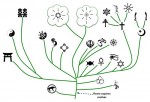
(This image created by Axis of Evo is not exactly what this entry is about, but it is an interesting use of a scientific technique to map out religions of the world.)
I wasn’t so sure what to expect when I went to the first lecture of the Earth Institute Practicum yesterday. The speaker was Bob Pollack of the Earth Institute’s Center for the Study of Science and Religion (CSSR). The first thing he did was tell us that the ideas of “right” and “wrong” are completely human constructs and that there is no evidence of them in nature.
So what is “natural” and how are science and religion connected?
Pollack’s definition of what is natural is biologically derived. DNA is the force by which things may naturally happen, and anything that happens by other means could be considered “unnatural” or derived from human imagination.
The biggest example of the latter that was discussed over the 2-hour seminar was language, not just as words, but also as ideas and general communication. Pollack explained that it was the main goal of CSSR to facilitate communication between science and religion and their practitioners. They certainly are not attempting to incorporate the two, but reconcile them so that they both can work to solve global issues.
Continue reading →
I attended a book launch today for Climate Change: Picturing the Science, hosted by the Columbia Climate Center of the Earth Institute at Columbia University.
The book is focused on how to take the science and communicate it through words and pictures. Leading climate scientists contributed to the writing of the chapters while the photographs were chosen based on what would explain and support the science.
The main authors, Gavin Schmidt and Joshua Wolfe, spoke on a panel with contributing authors Peter deMenocal and Stephanie Pfirman. Jeffrey Sachs gave a brief introduction (by video) and stressed the importance of having a worldwide understanding of the challenges that we face and that the defining component of any solution will be cooperation.
The moderator started with a few questions about the origins of the idea for the book, which was a photography show about climate change. Schmidt brought up the point that many of the books on climate change currently in stores are very political. This book, however, attempts to stay away from the politics and instead explain the science behind it all.
Continue reading →
On March 5th, 2009, at the top of the International Affairs Building at Columbia University gathered a diverse group of experts as part of the Earth Institute’s Seminars on Sustainable Development. Though their specialties ranged from Civil Engineering to environmental non-profit organizations, they spoke on a panel together on “Greening the Urban Economy.”
“What does this mean?” and “how can we make it happen?” were the questions buzzing around in the minds of audience members as they entered the room and enjoyed some of the refreshments and cookies in the back.
The audio equipment was tested and the projector flashed bits of presentations. People trickled in, curiously looking around the room while waiting for the guest speakers to make their appearance. Late afternoon light streamed in from both sides of the room. Finally, the equipment was all ready, the guest speakers arrived and the audience settled to quietly in their seats, but the anticipation still ran high.
With the economy in its current state, this topic is hotter than ever. During his part of the session, Jack McGourty put up this intriguing quote from Van Jones, author of The Green Collar Economy, and who was also recently named one of Rolling Stone Magazine’s 100 Agents of Change:
The twin crises of economic collapse and ecological devastation have proven that the old, pollution based economy has failed both the people and the planet the green money in the stimulus package is a down payment on a clean green economy that will serve both the people and the planet.
Recent comments
Tag Cloud
academia activism behavior climate change CNN conservation development Earth Institute ecohealth EcoHealth Alliance ecology economy education energy environmental decisions evolution fall farming food geography Google graduate students greenanswers.com green building human-environment conflict In Defense of Food Internet journal article knowledge LEED Michael Pollan music Nature New York nutritionism NYT policy recycling Science scientific literacy sociology summer urban farming vertical farming Wikinomics


Rosemary Grant and the Galapagos finches
April 24, 2009
Science, Some Comments
3 comments
As part of Columbia University’s Darwin Speaker Series, Rosemary Grant of Princeton University came to speak on April 14th, 2009 about evolution in Darwin’s finches.

Rosemary is an interesting woman, and her husband and research partner, Peter, an interesting man. People may unknowingly assume they are a typical cute older couple when passing them on the street. But what they have seen during their years of research on a few small islands may surpass in scope anything we may hope to witness in any one of our lifetimes.
This year being the 150th anniversary of On the Origin of Species, and the 200th anniversary of Darwin’s birth, it was fitting for Rosemary Grant to speak about her research on the island Daphne in the Galapagos Islands. The finches have radiated into over a dozen diagnosable species, some that share habitats and some living alone on their islands. The islands are so isolated that migrations are rare, but when they do occur, researchers are there to observe the events.
Continue reading →