It has been a just a few days past a year since I first posted on this blog. A lot has changed since then, the most significant of which is that I now have a great job!
Since starting that job, this blog has been greatly neglected. So with that in mind, I will try to post much more often (which may mean shorter posts, but I will try!).
Last night I saw FRESH, the movie. It is a documentary about food, agriculture, and the stories behind the people growing food.
Watch this trailer:
I generally enjoyed the film and the story that unfolded. It is different from other documentaries in that it does not rely too heavily on the facts to tell the story. It is more about using the imagery and the narrative to reach out to the audience.
I liked seeing the sustainably managed farms, and especially Will Allen’s work in an urban setting. The stark comparison to the scenes from industrial farms are a harsh reality that I wish more people could witness.
If you would like to see FRESH, you can get a home screening license to watch in a group with friends, or try to catch a screening near you.
I have yet to see Food, Inc., but I will be seeing it at the end of the month. Perhaps then I can make a fuller comparison.
The author of the NYT editorial I wrote about on August 4th brought up this idea:
“Domestically, a power company can earn credits by, say, helping farmers capture methane emitted by animal waste ponds or cultivate land in ways that help absorb carbon.”

I’ve read a few articles about these “black lagoons” (term borrowed from NYT article linked below) of animal waste created by farms, specifically pig farms. Recently, I started wondering whether people really understand what these farms are like. If you haven’t ready anything like The Omnivore’s Dilemma by Michael Pollan, you could live on not knowing what kind of atrocities there are out there that are connected to producing your food.
The animals raised on large lot farms are kept in close quarters, and can’t be near each other’s waste because it would make them sick. (Which is quite understandable. It would make me sick too.) So the waste needs to be trucked out of the animals’ barns and deposited somewhere, often on one big piece of land on the same farm. This turns the land into a black lagoon of animal waste that contaminates the soil, possibly the groundwater, toxic gas emission, and tons of other issues that affect the environment and the health of humans.
Continue reading →
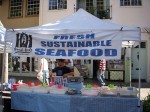
I’m somewhat of a skeptic when it comes to seafood sustainability. I doubt that any fish farming endeavor is completely waste-free or low-enough-ecological-impact to be done at the scale that would be needed to wean our culture off of a meat (and soy) industry that is tearing up the planet. You may not be aware, but much of the deforestation in South America is either for cattle raising or soy bean production. Much of the soy being grown is exported to be used as livestock feed, not for direct human consumption.
However, I do still think that it is necessary for most humans to have some animal protein in their diet (because our bodies have evolved this way). By “some,” I mean about the size of a deck of cards per week per adult. That is really all anyone who isn’t training or super active needs. (But of course, our tendency to want everything in excess defies self-control or self-denial.)
To help out, here are some links to a guide for how to judge your choices:
- http://www.montereybayaquarium.org/cr/SeafoodWatch/web/sfw_regional.aspx
- http://www.blueocean.org/seafood
- an interesting article!
Image Credit:
Flickr user SunnyvaleRocks
Will Allen is an urban farmer featured in this NYT article. He does interesting work in greenhouses to feed 10,000 local people. It is so exciting to see something great happening where it is needed most.
Urban centers, especially inner city areas, often lack access to fresh produce. This has enormous implications for health because, while it is easier to get a hamburger and fries for dinner, no one will be able to stop the obesity trends.
The article talks about composting and urban farming and the recent rise in appreciation and interest for such work.
The author seems to make a big deal about farming systems that close the cycle, using the “waste” to continue the growth and nutrient cycle.
But this is not something new!! We have been aware of these ecological principals for such a long time. By we, I mean scientists…and all the old school farmers who understood the relationships between all the living things on their farms.
There is no waste in Nature! That is the missing underlying idea that the author skips over. The history of how we are returning to this type of farming is not mentioned at all.
But the author makes a good point of bringing up the fact that farms like these are not and can not be self sufficient with the current condition. Will Allen’s farm receives grants and other types of support to keep up and running. For more similar farms to be successful, it has to become profitable. It makes me sad to say that, but it is basically true.
In any case, it is an enjoyable and informative article and I hope you read it!


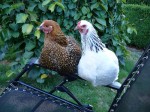
The chickens in the yard go cluck cluck cluck
August 14, 2009
Science, Society, Some Comments
(No comments)
This NYT article talks about the trend that is becoming more popular now of keeping chickens in backyards across the nation, such as Chicago, Brooklyn, and the rural West.

From the article, the general sense is that most of the people who recently started raising chickens in their backyards are doing it because of the economic recession. A common sentiment that is repeated in the article is that people want to feel secure, just in case they lose their job or the recession gets worse.
Possibly the most difficult thing about raising animals is feeding them. The problem with raising the chickens in backyards is that you spend nearly as much as you could make just by buying feed for the chickens. There are also the initial costs of providing shelter and purchasing the chicks.
Compared to farms that purchase feed in bulk or have enough land to rotate the chickens on plots of grass, raising your own chickens is inefficient. You are hardly saving any money while increasing the hassle for your household.
Continue reading →