"We cannot solve our problems with the same thinking we used when we created them."

Albert Einstein

The author of the NYT editorial I wrote about on August 4th brought up this idea:
“Domestically, a power company can earn credits by, say, helping farmers capture methane emitted by animal waste ponds or cultivate land in ways that help absorb carbon.”

3180395684_0eb3d8379c

I’ve read a few articles about these “black lagoons” (term borrowed from NYT article linked below) of animal waste created by farms, specifically pig farms. Recently, I started wondering whether people really understand what these farms are like. If you haven’t ready anything like The Omnivore’s Dilemma by Michael Pollan, you could live on not knowing what kind of atrocities there are out there that are connected to producing your food.

The animals raised on large lot farms are kept in close quarters, and can’t be near each other’s waste because it would make them sick. (Which is quite understandable. It would make me sick too.) So the waste needs to be trucked out of the animals’ barns and deposited somewhere, often on one big piece of land on the same farm. This turns the land into a black lagoon of animal waste that contaminates the soil, possibly the groundwater, toxic gas emission, and tons of other issues that affect the environment and the health of humans.
Continue reading →

InDefenseFood
As promised, though a bit late, here are some general guidelines for buying and consuming food as suggested by Michael Pollan in the ending chapters of In Defense of Food.

He covers a lot of ideas while giving some advice and I will summarize here some of the ones I think are key. I really recommend reading the book for some great stories, examples, and information in addition to more detailed advice!


1. “Eat food.”

When it comes to eating, humans have evolved to eat natural plant and animal products. A vast amount of the food found in markets and on shelves, however, have been processed past the point of recognition. Pollan suggests eating things that your great-grandparents would still be able to identify as food. He makes the point that all the whole foods tend to be on the outsides of the supermarket (in the produce, meat, and dairy sections). So stay away from those boxed goodies that big companies spend all that advertising to get you to buy it!

Continue reading →

2308738836_b68cae35e2_b
“Helps lower cholestorol.”
“Natural source of antioxidants.”
“Low fat.”
“Made with all natural ingredients.”

You’ve probably seen them all. All these are health claims you might come across in any typical grocery store. The natural instinct for the consumer is to trust these types of statements. They are often backed by a government agency, after all. But what does it mean to be a “qualified” health claim.

390331582_8caebdbefb
Here is a quote from Michael Pollan, on page 156 of In Defense of Food,

“The FDA’s own research indicates that consumers have no idea what to make of qualified health claims (how would they?), and its rules allow companies to promote the claims pretty much any way they want – they can use really big type for the claim, for example, and then print the disclaimers in teeny-tiny type.”

Continue reading →

One main point that Michael Pollan brings up is the general shift from complexity to simplicity. He means that nutritional quality is eventually sacrificed because the complex interactions and combinations of nutrients are being simplified by industrializing and processing food.
the Christmas spread romanlily
Biological and ecological interactions that culminate in the plant and animal products that we consume are very complex and difficult to imitate. But this seems to be the ultimate goal for food science, as exemplified by the several trends in fortifying processed foods with the ever evasive “magic nutrient” that is essential for good health.

To quote Pollan (page 115), “Chemically simplified soil would produce chemically simplified plants.”

These ideas make me question the true feasibility of vertical farming. Reductionist research has brought this concept to where it is today, but what if all of this is in vain because of our lack of understanding? Specifically, our understanding about the complexity of interactions and nutrients that create our food and nourish our bodies?
Continue reading →

A good quote from page 62 of In Defense of Food:

“The problem with nutrient-by-nutrient nutrition science,” points out Marion Nestle, a New York University nutritionist, “is that it takes the nutrient out of the context of the food, the food out of the context of the diet, and the diet out of the context of the lifestyle.”

Whole foods are so complex chemically and biologically that there is no way that we could recreate its nutritional value in processed foods.

More on this later.

InDefenseFood_cover_thumb

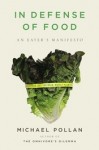
I just started reading Michael Pollan’s In Defense of Food. I read The Omnivore’s Dilemma about a year and a half ago and found it very perspective-changing so I am looking forward to what this book will have to say.

The first few chapters have focused on discussion of the ideology behind “nutritionism.” Pollan points out that this is not a scientific term, though there is “food science” that is involved.

Nutritionists and food scientists seem to have an unusual amount of power over the thoughts, perceptions, and actions of the general public. The pervading misconception is that the key to understanding food is to look at the nutrients and break it down in a reductionist manner, or, as Pollan puts it, that “foods are essentially the sum of their nutrient parts.”
Continue reading →