"We cannot solve our problems with the same thinking we used when we created them."

Albert Einstein

Stuart Firestein was the guest speaker at this month’s Secret Science Club. His area of research is neuroscience and the olfactory system, but at this talk he discussed his ideas on ignorance and how it is important for driving scientific research.

Ignorance, according to Firestein, is what drives science because discoveries do not happen as a result of sequential studies and reasoning. It is more like searching in a dark room for a black cat (his example), although sometimes there won’t be a black cat at all. It may be difficult for career scientists to admit that they don’t have a clear idea of what they are doing or looking for, but asking those questions to get at what we don’t know and how to get there is what is important to the process.

I put ignorance in quotes because it does have a lot of negative connotations, like Firestein admits, but I think those negative connotations are sometimes too dominant to justify using the word plainly. I think there should be a better word for it, but don’t have something in mind at the moment, so the quotation marks.

Make Your Own Path

Another issue he talks about is the vastness of knowledge. How can we possibly keep up with all of the knowledge found and advances in science? I cannot keep up with ecology journal articles, much less the weekly issues of Nature and Science (which are the gold standard in academic publishing). With the increasing pace of publishing academic articles, there is also an increase in field-specific jargon. The bar to enter a field and be an expert gets set higher and higher each year, and to know one’s field becomes a really tough prerequisite to being a respected researcher (and to getting tenure for those who really care about that).

Dr. Firestein teaches an interesting seminar course at Columbia University, where prominent researchers come in and discuss what they don’t know and what they want to know in their field. It is this type of discussion that brings the research to a more universally understandable level, because the jargon doesn’t exist yet for things we don’t know about. I really like this point because I agree that it is so hard to even read a single academic article in a field that I am not active in, but I can relate to discussion in terms of the unknowns.

Firestein also said some interesting things about hypotheses (and the scientific method). He doesn’t like them, and I agree. He argues that hypotheses open up research to biases (or, more boldly put, pigeonhole research into biases and expectations), whereas more curiosity-driven open-ended questioning avoids bias in some ways. But the way to get funding for your research is to describe and structure your studies in a hypothesis-driven way. Basically, the scientific method is bogus!

If I was able to ask Dr. Firestein a question, I would ask him how he feels about the lack of interest in publishing negative results. Meaning, studies that come up short of significant results, but still might have some interesting intellectual value by informing people about what didn’t happen. I can imagine a new academic journal going by the title of “Ignorance,” but that might not give much confidence to researchers who are looking to publish. (Update on May 29, 2012: Here is a post about this very topic talked about in Nature!)

This talk couldn’t have come at a better time as I’m getting closer to doing my own research projects (I’ll post more on this later). I don’t have any hypotheses, although I have some questions, some thoughts and a short plan. But, I think it’s ok not to have set plan. Most of the time.

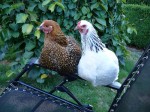
This NYT article talks about the trend that is becoming more popular now of keeping chickens in backyards across the nation, such as Chicago, Brooklyn, and the rural West.
2870518715_23d881be23
From the article, the general sense is that most of the people who recently started raising chickens in their backyards are doing it because of the economic recession. A common sentiment that is repeated in the article is that people want to feel secure, just in case they lose their job or the recession gets worse.

Possibly the most difficult thing about raising animals is feeding them. The problem with raising the chickens in backyards is that you spend nearly as much as you could make just by buying feed for the chickens. There are also the initial costs of providing shelter and purchasing the chicks.

Compared to farms that purchase feed in bulk or have enough land to rotate the chickens on plots of grass, raising your own chickens is inefficient. You are hardly saving any money while increasing the hassle for your household.
Continue reading →

Will Allen is an urban farmer featured in this NYT article. He does interesting work in greenhouses to feed 10,000 local people. It is so exciting to see something great happening where it is needed most.

Urban centers, especially inner city areas, often lack access to fresh produce. This has enormous implications for health because, while it is easier to get a hamburger and fries for dinner, no one will be able to stop the obesity trends.

The article talks about composting and urban farming and the recent rise in appreciation and interest for such work.

The author seems to make a big deal about farming systems that close the cycle, using the “waste” to continue the growth and nutrient cycle.

But this is not something new!! We have been aware of these ecological principals for such a long time. By we, I mean scientists…and all the old school farmers who understood the relationships between all the living things on their farms.

There is no waste in Nature! That is the missing underlying idea that the author skips over. The history of how we are returning to this type of farming is not mentioned at all.

But the author makes a good point of bringing up the fact that farms like these are not and can not be self sufficient with the current condition. Will Allen’s farm receives grants and other types of support to keep up and running. For more similar farms to be successful, it has to become profitable. It makes me sad to say that, but it is basically true.

In any case, it is an enjoyable and informative article and I hope you read it!

May 27, 2009

Features, Society

2 comments

(This piece was written Fall 2007.)

Our perception of Nature has everything to do with the way that we live our lives. People who trivialize the importance of nature to their daily lives take for granted what Nature has given and allowed us to accomplish. It may seem that we may rely on Nature’s resources indefinitely, but at what cost to Nature? Our time on Earth has been but a few blinks of the eye in the great geological scale of time yet the impacts that we have made while “conquering” our domain will most likely last for much longer. Differing perspectives on Nature will define the relationships and the types of interactions that we have with Nature.

Two great thinkers who approach this topic are William Cronon and Aldo Leopold. Both believe that the characteristics of man’s relationship with Nature depend on how man approaches Nature. The overarching Western idea that the Earth with its natural resources were meant for man’s use and progress came to the Americas with the Europeans. Several thinkers argue that this school of thought is deeply rooted in religion, and so is that much more ingrained in the culture. Followers were taught that the resources given to man by nature were limitless and for the taking while in other parts of the world people believe in the interconnectedness of all things in the world. This fundamental difference in thought has lead to many advances in society but at the expense of the natural world (i.e. the Industrial Revolution).

Cronon’s article titled “The Trouble with Wilderness; or Getting Back to the Wrong Nature” discusses the common interpretations during his time of the idea of “wilderness” and why that is important to the way the public views and thinks about Nature. One of his major points is that the “wilderness” to most people during the colonization of this nation was a savage and dangerous place in need of “conquering.” The Frontier was for everyone’s taking. Once the wilderness was conquered, however, the perception of nature is changed. People began to think of the wilderness as something to use for their own benefits and economic gains. Eventually, the frontier no longer existed and this passing of the frontier started people thinking that maybe something should be done to prevent complete loss of their beloved “wilderness.”
Continue reading →