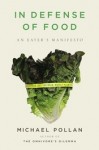
A good quote from page 62 of In Defense of Food:
“The problem with nutrient-by-nutrient nutrition science,” points out Marion Nestle, a New York University nutritionist, “is that it takes the nutrient out of the context of the food, the food out of the context of the diet, and the diet out of the context of the lifestyle.”
Whole foods are so complex chemically and biologically that there is no way that we could recreate its nutritional value in processed foods.
I just started reading Michael Pollan’s In Defense of Food. I read The Omnivore’s Dilemma about a year and a half ago and found it very perspective-changing so I am looking forward to what this book will have to say.
The first few chapters have focused on discussion of the ideology behind “nutritionism.” Pollan points out that this is not a scientific term, though there is “food science” that is involved.
Nutritionists and food scientists seem to have an unusual amount of power over the thoughts, perceptions, and actions of the general public. The pervading misconception is that the key to understanding food is to look at the nutrients and break it down in a reductionist manner, or, as Pollan puts it, that “foods are essentially the sum of their nutrient parts.”
Continue reading →
Recent comments
Tag Cloud
academia activism behavior climate change CNN conservation development Earth Institute ecohealth EcoHealth Alliance ecology economy education energy environmental decisions evolution fall farming food geography Google graduate students greenanswers.com green building human-environment conflict In Defense of Food Internet journal article knowledge LEED Michael Pollan music Nature New York nutritionism NYT policy recycling Science scientific literacy sociology summer urban farming vertical farming Wikinomics


Molecular gastronomy…is not your typical food science
August 30, 2009
Books and Stuff to Read, Science, Some Comments
(No comments)
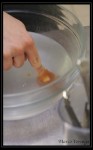
Also an article in the book The Best American Science Writing 2007 is a piece called “Cooking for Eggheads” by Patricia Gadsby on molecular gastronomy, which is the study of the physical and chemical processes that go into cooking food.

It is interesting to think about this field of science and compare it to what nutritionists do. Nutritionists try to break food down into their essential parts and attempt to inject things where they do not naturally belong. Molecular gastronomists, on the other hand, are scientists who want to know what is happening to the molecular structures in food when they are cooked or otherwise manipulated.
Gadsby talks about how one person she interviewed, Hervé This (pronounced Tiss), demonstrated that the texture of cooked eggs is completely determined by the temperature, not the time, at which they are cooked. A few degrees make a difference because different proteins in the yolk and white coagulate at different temperatures in the range of 142-184˚F.
Hervé This makes the point that what molecular gastronomists are interested in is figuring out the mechanisms, but people who throw around the term molecular gastronomy to describe fancy cooking techniques essentially should not be considered representative of this field of science. Molecular gastronomists are more like the physicists who are looking to find the laws of the universe, just instead of the universe they are interested in the laws of food and cooking. But like nutritionism giving the false perception of understanding the composition of food, showy restaurant chefs are giving the public a misconstrued image of molecular gastronomy.
But there is a good side to everything, and exposing people to new techniques draws attention and recognition to the field. The tricky part is then to convince those people that there is a greater purpose to experimenting with food than to just have a cool trick to show. Molecular gastronomy brings us closer to understanding the complex nature of different types of food applied to heat and other external forces. By understanding these processes, we may get closer to finding out what makes food nutritious and how to maximize that nutritional value.
Image credit:
Flickr user Marco Veringa