Here are some articles a friend sent to me recently (thanks Katie!).
I posted earlier about piezoelectricity being used in dance clubs and subway turnstiles, but here is an article about a smaller version that could be used in cell phones.
The second article is about gecko tape. Geckos have a really fascinating ability to climb on the pads of their feet using Van der Waals interactions between the tiny setae (each with a diameter of 5 micrometers) on the pads of the toes and the surface of the thing it is sticking to. The article says that tape and adhesive technology being developed now that imitates the gecko’s abilities may be available on the market in 3-5 years!
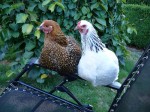
This NYT article talks about the trend that is becoming more popular now of keeping chickens in backyards across the nation, such as Chicago, Brooklyn, and the rural West.

From the article, the general sense is that most of the people who recently started raising chickens in their backyards are doing it because of the economic recession. A common sentiment that is repeated in the article is that people want to feel secure, just in case they lose their job or the recession gets worse.
Possibly the most difficult thing about raising animals is feeding them. The problem with raising the chickens in backyards is that you spend nearly as much as you could make just by buying feed for the chickens. There are also the initial costs of providing shelter and purchasing the chicks.
Compared to farms that purchase feed in bulk or have enough land to rotate the chickens on plots of grass, raising your own chickens is inefficient. You are hardly saving any money while increasing the hassle for your household.
Continue reading →
The author of the NYT editorial I wrote about on August 4th brought up this idea:
“Domestically, a power company can earn credits by, say, helping farmers capture methane emitted by animal waste ponds or cultivate land in ways that help absorb carbon.”

I’ve read a few articles about these “black lagoons” (term borrowed from NYT article linked below) of animal waste created by farms, specifically pig farms. Recently, I started wondering whether people really understand what these farms are like. If you haven’t ready anything like The Omnivore’s Dilemma by Michael Pollan, you could live on not knowing what kind of atrocities there are out there that are connected to producing your food.
The animals raised on large lot farms are kept in close quarters, and can’t be near each other’s waste because it would make them sick. (Which is quite understandable. It would make me sick too.) So the waste needs to be trucked out of the animals’ barns and deposited somewhere, often on one big piece of land on the same farm. This turns the land into a black lagoon of animal waste that contaminates the soil, possibly the groundwater, toxic gas emission, and tons of other issues that affect the environment and the health of humans.
Continue reading →
The Senate is in a position to pass a climate change bill aimed at the energy industry. There are some things that were changed through much of the politicking going on, and it is unsure whether the bill would be successful at doing much in the way of reducing emissions.
Here are a few opinions:
- http://www.nytimes.com/2009/07/22/opinion/22wed11.html?_r=1
- http://www.nytimes.com/2009/08/02/opinion/lweb02climate.html
Whichever method is chosen, something should be done soon. If cap-and-trade policy is less effective than taxing carbon, then we will find out and should be flexible to adapt our policy.
We WILL NOT get things right the first time around! We cannot expect to! Policy should not be written and left stagnant anyway! But we can’t afford to argue back and forth about which policy will work better. That would take way too long to make anything happen.
We are missing the point by debating over what type of policy would work better. We should be open and flexible while ensuring that whatever policy is implemented is as strong as it can be, predicts any abuses, and doesn’t have any loopholes.
Continue reading →
We all have a friend who is one. An electricity-hog. A 45-minute-showerer. The drive-to-the-gym-so-I-can-run-in-place kind of person. The most common of these types of habits among young adults today seems to be the excessive bad computing habits, like leaving a computer on when it isn’t being used (especially overnight) and printing things that don’t need to be printed.
Computing and printing habits are some of the toughest to break in our culture of excessive everything (perhaps not as tough as that of food, but still tough).
GreenPrint is a computer software company trying to battle these habits by giving the user more control over what gets sent to the printer. (NYT article and gadgetwise blog) There is also a corporate edition that could really make a difference in the workplace.
However, as useful as GreenPrint may be, it is not really getting at the heart of the issue. There might be less paper being used for each specific print job, but the number of print jobs might even increase because people feel they can print more often since they have been saving up “printing credits.”
Instead of printing something to look at for a few days, hours, minutes, whatever, there has to be a change in judging what is necessary to print or just a better way of having a copy in your hands (perhaps e-ink? E-ink is the technology that is used in Amazon’s Kindles and Sony’s Reader as well as other reading devices).
What really needs to happen is the change in mentality of users. Much like the ideas that Michael Pollan promotes regarding food portion sizes, the solution might not be to force the shaving of fractions of what is being used, but to fundamentally change what we think is an acceptable level of use.
Image credit
GreenPrint http://www.printgreener.com/images/logo.gif


Detecting lies in the 21st century
August 25, 2009
Books, Commentary, Science, Society, Technology
2 comments
I am currently reading the book The Best American Science Writing 2007, and in it was an article about lie detecting by Robin Marantz Henig entitled Looking for the lie that was published in the New York Times Magazine. (Just so you know, there is no scientific evidence to suggest that polygraphs can detect lies at very high accuracy.)

Towards the end of her piece, Henig discusses some of the evolutionary implications pertaining to deception and the development of the brain. Advanced social interactions are complex and often deception needs to be part of the equation and might be somewhat related to skills that make individuals socially adapted and intelligent.
This idea is interesting because it would explain a lot of the selfish behavior that we see in humans today. Social groups that are small enough may not suffer as much from serious deceptive offences, though they definitely have their share of gossiping, etc.
But as social groups get bigger, relationships are not as much defined by kinship but by association and profession. Being able to lie or deceive may have become adaptive in these settings where it would be the difference between gaining an advantage over a competitor or getting the short end of the stick.
Continue reading →