Richard Feynman has a quirky voice, adeptly captured by this book. I hope that someday I’ll have a quarter as many good stories as he seems to have. One thing that I truly admire about him is that he is completely open and is always up for a new experience or adventure. My favorite is the one where he wants to volunteer when they tell the student body that a hypnotist will be coming to the university. There are quite a few that are really funny, but this one cracks me up when I imagine it happening.
His approach to life is something that I aspire to. Although I’m not very physics-minded, it was cool to read about the work he’s done and get a glimpse into how his mind works. He always thought of things in practical terms, and especially when thinking about physics problems he would ask for a real life example to work through in his head. He is one of those people who just needs to know how things work, how they actually work. What about the things he has done for the military? He does talk about his time at Los Alamos, but mostly doesn’t go into the details of the physics or the gravity of what the work was.
One of the major concepts I like from him is that of cargo cult science and waiting for something to come that will never land. He explains it by going back to when tribes on desolate islands would be visited by cargo planes full of supplies and things they needed. The people would then become taken by the idea that some cargo plane will again come and give them what they need. So they wait around, build landing strips, for a plane that is not coming.
Deciding not to decide anymore
There is a part of the book that talks about when he was trying to decide between staying at Cornell or going to Caltech. The snow in Ithaca made him want to go to Caltech, and then there were some air pollution issues that made him think about going back to Cornell. Then he was stopped by some colleagues on campus who told him about their newest discoveries. He realized he wanted that type of environment where he could walk around and hear about all the different cool discoveries in other fields, and he decided would just stop deciding and stay at Caltech.
Reading this was great because I’m currently feeling a bit sheepish for going back on my plan to not do a PhD program. I’m deciding not to decide anymore about whether I want to do a PhD or not. It isn’t the years of hard work that I’m wary of, because anything I do I would want to work hard at it. It is the academic situation that I’m wary of (and lack of jobs on the traditional path following PhDs, but maybe I’m just not on a traditional path anymore anyway). What I will do is follow paths that feel right to me, and that lead to more interesting things. So, PhD programs in USA don’t feel right to me, at least not now. But, this other new opportunity does feel right to me. I would get to do interesting work, learn new skills, and do some living and traveling abroad. And no need to feel any anxiety, I don’t have to feel like I’m signing myself up for a life in academia, because only those who really want them get academic jobs and there are options outside of academia. I’m putting to rest these thoughts and just going to focus on what lies ahead.
In any case, Feynman definitely has had an interesting life and has inspired me to go out and do the things that I’ve been thinking about doing (like living abroad, and throwing myself into learning new skills)! I’ll go where curiosity takes me, and if this PhD position makes that possible, then so be it!
Stuart Firestein was the guest speaker at this month’s Secret Science Club. His area of research is neuroscience and the olfactory system, but at this talk he discussed his ideas on ignorance and how it is important for driving scientific research.
Ignorance, according to Firestein, is what drives science because discoveries do not happen as a result of sequential studies and reasoning. It is more like searching in a dark room for a black cat (his example), although sometimes there won’t be a black cat at all. It may be difficult for career scientists to admit that they don’t have a clear idea of what they are doing or looking for, but asking those questions to get at what we don’t know and how to get there is what is important to the process.
I put ignorance in quotes because it does have a lot of negative connotations, like Firestein admits, but I think those negative connotations are sometimes too dominant to justify using the word plainly. I think there should be a better word for it, but don’t have something in mind at the moment, so the quotation marks.
Another issue he talks about is the vastness of knowledge. How can we possibly keep up with all of the knowledge found and advances in science? I cannot keep up with ecology journal articles, much less the weekly issues of Nature and Science (which are the gold standard in academic publishing). With the increasing pace of publishing academic articles, there is also an increase in field-specific jargon. The bar to enter a field and be an expert gets set higher and higher each year, and to know one’s field becomes a really tough prerequisite to being a respected researcher (and to getting tenure for those who really care about that).
Dr. Firestein teaches an interesting seminar course at Columbia University, where prominent researchers come in and discuss what they don’t know and what they want to know in their field. It is this type of discussion that brings the research to a more universally understandable level, because the jargon doesn’t exist yet for things we don’t know about. I really like this point because I agree that it is so hard to even read a single academic article in a field that I am not active in, but I can relate to discussion in terms of the unknowns.
Firestein also said some interesting things about hypotheses (and the scientific method). He doesn’t like them, and I agree. He argues that hypotheses open up research to biases (or, more boldly put, pigeonhole research into biases and expectations), whereas more curiosity-driven open-ended questioning avoids bias in some ways. But the way to get funding for your research is to describe and structure your studies in a hypothesis-driven way. Basically, the scientific method is bogus!
If I was able to ask Dr. Firestein a question, I would ask him how he feels about the lack of interest in publishing negative results. Meaning, studies that come up short of significant results, but still might have some interesting intellectual value by informing people about what didn’t happen. I can imagine a new academic journal going by the title of “Ignorance,” but that might not give much confidence to researchers who are looking to publish. (Update on May 29, 2012: Here is a post about this very topic talked about in Nature!)
This talk couldn’t have come at a better time as I’m getting closer to doing my own research projects (I’ll post more on this later). I don’t have any hypotheses, although I have some questions, some thoughts and a short plan. But, I think it’s ok not to have set plan. Most of the time.
Prominent researchers gathered on Feb. 2nd, 2012 for a panel discussion, sponsored by the New York Academy of Sciences (NYAS), to discuss the moratorium on H5N1 research. Should researchers publish their studies? Would it be a threat to security if the wrong people were able to use their findings?
As much as academia may think that they are insulated against modern affairs, what they do in their labs and in their field research often is greatly connected to the daily concerns of global citizens. This is normally not so visible through the current system of publishing in high-level peer reviewed journals, which may or may not trickle down through media outlets.
But as much as the general citizen should like to know about their research, this opens up the possibility of good work to be co-opted by less good people. This is where the danger lies. Many folks are concerned that this H5N1 research is too dangerous to publish, because it involved experiments with a strain in a model organism and could lead to “weaponizing” of the virus to infect and transmit between humans easily.
To view the video recordings of the panel discussion, go to the NYAS website.
Should they extend the moratorium? How much should they publish about their research? Would it help or hurt?
This is an interesting issue because never before have we been at this point where we need to know more to understand, but by finding out more we are also creating new problems with security risk. How can we censor science? Should we? To what extent?
For more reading:
If I were ever to have a video as a desktop background, one of these would probably be it! (But I probably never would because it would use up too much electricity to keep it going.) Take a look:
‘Preener’ from MORPHOLOGIC on Vimeo.
‘Corynactis viridis’ from MORPHOLOGIC on Vimeo.
These videos are from Morphologic, a science/art initiative based in Miami and led by a marine biologist, Colin Foord. and a designer, Jared McKay.
Thanks to Deep Sea News (who found it on Boing Boing)!

Image credit: Flickr user Colin Purrington
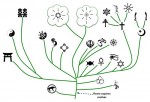
(This image created by Axis of Evo is not exactly what this entry is about, but it is an interesting use of a scientific technique to map out religions of the world.)
I wasn’t so sure what to expect when I went to the first lecture of the Earth Institute Practicum yesterday. The speaker was Bob Pollack of the Earth Institute’s Center for the Study of Science and Religion (CSSR). The first thing he did was tell us that the ideas of “right” and “wrong” are completely human constructs and that there is no evidence of them in nature.
So what is “natural” and how are science and religion connected?
Pollack’s definition of what is natural is biologically derived. DNA is the force by which things may naturally happen, and anything that happens by other means could be considered “unnatural” or derived from human imagination.
The biggest example of the latter that was discussed over the 2-hour seminar was language, not just as words, but also as ideas and general communication. Pollack explained that it was the main goal of CSSR to facilitate communication between science and religion and their practitioners. They certainly are not attempting to incorporate the two, but reconcile them so that they both can work to solve global issues.
Continue reading →
Recent comments
Tag Cloud
academia activism behavior climate change CNN conservation development Earth Institute ecohealth EcoHealth Alliance ecology economy education energy environmental decisions evolution fall farming food geography Google graduate students greenanswers.com green building human-environment conflict In Defense of Food Internet journal article knowledge LEED Michael Pollan music Nature New York nutritionism NYT policy recycling Science scientific literacy sociology summer urban farming vertical farming Wikinomics


The non-PhD route
September 27, 2011
Some Comments
8 comments
What does it mean, to be a PhD? It’s different in different places, of course. There have been several articles published on this topic, for me most notably in Nature and the Economist.
The idea of doing some research that I’m extremely interested in is still very appealing to me. It’s just that…I don’t want to do the PhD to get there, and it may not really be necessary. Like in the Nature article, there are ways to get involved in research at the entry or mid-level. I just won’t be able to be a Principal Investigator (PI) on any grant proposals.
And I’m glad of it! Being a PI comes with great expectations and responsibilities. You are tasked with accomplishing the Great and Many things that you promised in the proposals, and at the same time you have to stay within The Budget. Then you have to get your work published in High Impact Journal A or High Impact Journal B, and then compete with peers all over again for more funding.
Not to mention, when you exit with your PhD, your options are both limited and wide-ranging at the same time. Limited in that you probably won’t want to settle for something that pays less or doesn’t acknowledge your Killer Skills or Awesome Expertise. And you do come out an expert…in a very very very specific area, which in turn may lead to more limitation. Your options are wide-ranging in the way that you could go to many different places in the world, granted that there are people who want you on their team. But even that seems to ultimately be somewhat limiting, because jumping from place to place is not conducive to the paper-publishing feedback-loop of a career of the PhD.
I’m not bashing on PhDs, or the system (though it seems very flawed). I’m just saying here, out loud, finally, that I’ve changed my mind and it isn’t for me. I’ve got my Masters, and that might be enough. Who knows, maybe I’ll change my mind, but I’m not going to feel bad about this choice or any other subsequent choice. I’m not 100% sure where I’m headed now, but I’m excited about figuring it out and going with wherever it takes me.
Whew! That was a load off! I hope I haven’t disappointed you.