"We cannot solve our problems with the same thinking we used when we created them."

Albert Einstein

September 23, 2009

Features, Society, Technology

(No comments)

Last friday, I volunteered at the Solar-Powered Film Series hosted by Solar One and Green Edge NYC. I found out about this event from Green Edge NYC (specifically Patricia Curry). It was great to meet up with people doing great work in New York regarding sustainability and community outreach! Thanks should go out to both organizations who put on a great series!

This night’s film was The Garden, about a group of urban farmers in L.A. who started their 14 acre garden after the riots in 1992. They go through some hardship starting in 2004 when they have to fight to prevent eviction.

It was an emotional film! It was frustrating how unsympathetic to farming the people trying to get the land were. The community went through several legal difficulties during their fight. I felt worked up about protecting the plants and the relationship that the people developed with the plants, more than the human interests involved. So many of the trees they planted were producing fruit and took many years to reach that point, and the community gained so much from their relationship with the land. But if you watch the film, you will see what happened. The film also brings to the fore the reality that many groups are constantly in conflict with each other because of things like land and development. There are many ways that things could have gone, and the film documents this journey.

Here is a video/slideshow that I made from the pictures and video I took of the events:

Continue reading →

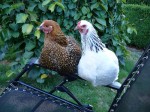
This NYT article talks about the trend that is becoming more popular now of keeping chickens in backyards across the nation, such as Chicago, Brooklyn, and the rural West.
2870518715_23d881be23
From the article, the general sense is that most of the people who recently started raising chickens in their backyards are doing it because of the economic recession. A common sentiment that is repeated in the article is that people want to feel secure, just in case they lose their job or the recession gets worse.

Possibly the most difficult thing about raising animals is feeding them. The problem with raising the chickens in backyards is that you spend nearly as much as you could make just by buying feed for the chickens. There are also the initial costs of providing shelter and purchasing the chicks.

Compared to farms that purchase feed in bulk or have enough land to rotate the chickens on plots of grass, raising your own chickens is inefficient. You are hardly saving any money while increasing the hassle for your household.
Continue reading →

Will Allen is an urban farmer featured in this NYT article. He does interesting work in greenhouses to feed 10,000 local people. It is so exciting to see something great happening where it is needed most.

Urban centers, especially inner city areas, often lack access to fresh produce. This has enormous implications for health because, while it is easier to get a hamburger and fries for dinner, no one will be able to stop the obesity trends.

The article talks about composting and urban farming and the recent rise in appreciation and interest for such work.

The author seems to make a big deal about farming systems that close the cycle, using the “waste” to continue the growth and nutrient cycle.

But this is not something new!! We have been aware of these ecological principals for such a long time. By we, I mean scientists…and all the old school farmers who understood the relationships between all the living things on their farms.

There is no waste in Nature! That is the missing underlying idea that the author skips over. The history of how we are returning to this type of farming is not mentioned at all.

But the author makes a good point of bringing up the fact that farms like these are not and can not be self sufficient with the current condition. Will Allen’s farm receives grants and other types of support to keep up and running. For more similar farms to be successful, it has to become profitable. It makes me sad to say that, but it is basically true.

In any case, it is an enjoyable and informative article and I hope you read it!

sciencebarge

That might sound like a strange idea, but it is possible! The Science Barge is a floating farm museum, currently docked in Yonkers, NY, that aims to bring awareness about urban farming. They claim to grow tomatoes, lettuce, and cucumbers with zero carbon emissions, zero pesticides, and zero runoff. Thousands of schoolchildren, adults, and press people have visited the barge since it opened in 2007.

They use hydroponics to grow their vegetables, which is also a large component of vertical farming. When I spoke to Dickson Despommier, he implied that large scale urban or indoor farming is not possible without hydroponic technology. Considering the lack of space or soil in New York City, I tend to agree with him, though I am not an expert on hydroponics.


The barge presents an interesting way to get the public interested in urban farming. Though it is just a museum, it is a great step in the right direction to getting people to think about getting their food through low-impact methods. If hydroponic farming could be done on a larger scale, either through more barges or vertical farming, the barge has the important role of easing this idea into the public eye. Education is key!


For more pictures of the Science Barge, check out this New York Times slideshow or Flickr slideshow.


(On a side note, a friend recently gave me a copy of the book The Lorax signed by Dickson Despommier as a graduation gift!)

Image credit: NYSunworks.org